

| Cinque Terre |
|
 |
RIOMAGGIORE.
It raises at the mouth of a
rapid Apennine stream, the
Romans' "Rivus Major", today
covered and paved. According to
the tradition, this village was
first built in the 8th century
when a group of Achaeans,
escaped from the persecution of
the Byzantine emperor Leo III,
found shelter there.
|
|
|
| The nice walk from the
top of the village to the Sanctuary of
the Madonna del Monte Nero (Black Mount
Madonna) offers a wonderful view of the
Cinque Terre. |
|
|
 |
|
|
 |
MANAROLA.
Situated on a rocky pedestal
overhanging the sea,
Manarola
looks as a compact group of
houses brightly coloured, almost
all with a terrace on the top,
i.e. the typical "cassola" where
in September, after the grape
harvest, the best grapes are
lied in the sun to obtain the
wine called Sciacchetrà.
|
|
| Here, like in
Riomaggiore, the stream that flows
between the houses is almost completely
covered today and forms the current main
street which ends at the characteristic
square cut in the rocks, where boats are
hoisted with the strength of one's arms.
The chessboard square of the S. Lorenzo
church, in the village upper part, often
becomes - out of necessity - a playing
round for kids, whose joyful voice
replaces the noise of cars. Now a
deviation towards Groppo and Volastra -
two quiet inland hamlets - is worth the
while. Half an hour walk on a path
amidst vines and century-old olive trees
leads to the top of the Volastra hill
where the light air and the large green
opening surrounded by trees in front of. |
|
 |
|
 |
CORNIGLIA.
This village, which looks more
like a rural than a seafaring
village, is the only one in
which houses are not directly on
the sea, and rises on the top of
a headland. On the surrounding
hills, vines and olive trees are
grown and it is normal to bump
into women that go or come from
the "cian"
|
|
| (vineyard plans) with
baskets and bundles on their
heads. The first part of the
path that leads to
Vernazza is protected
by another dry masonry which shelters
from the sun and the wind that often
blows very strongly from the sea: the
path winds around twisted olive trees
and goes up again to the top of other
hills covered by holm-oaks and pinasters.
At half the way it is possible to go
down and reach the sea by a quick hardly
traced path that reveals the beautiful
and isolated Guveno beach. |
|
 |
|
 |
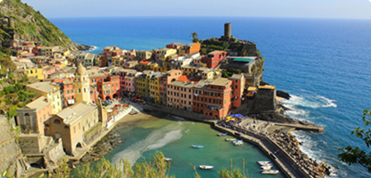
VERNAZZA.
The ancient Vulneria maintains
the characteristic medieval
village look and boasts the most
ancient seafaring traditions of
all the Cinque Terre. The tall
houses on the promontory are
grouped in an amphitheatre shape
around a small bay: they are
dominated by the massive
defensive walls and the ancient
Castle Tower.
|
|
| The climb to the Castle
offers one of the most varied views that
can be imagined: the narrow and dark
carrugi (ancient narrow streets) meet
the steep "arpaieXXXX" (narrow stairs)
and above the doors of pink or yellow
houses there can be seen the small
niches containing votive statues. Boats
are hoisted on the small piazza on which
old arcades and rustic shops open, in
front of S. Margherita of Antiochia
church, featuring the characteristic
octagonal bell tower.
Vernazza is a stop
for the boats that carry out the tourist
service from Portovenere to
Monterosso. |
|
 |
|
 |
MONTEROSSO.
Long accessible from Levanto
through the carriage road, it is
undoubtedly the most visited
tourist resort among the
Cinque
Terre. From the Capuchin
Monastery and, further above,
from the ancient Fieschi's
Castle - today a cemetery - the
glance can reach a large portion of
coast, enjoying a
|
|
| marvellous panoramic
view: on one side the steep Punta Masco,
featuring the S. Antonio abbey's ruins,
on the other the steep coast covered
with vines where you can see
Vernazza,
Corniglia and
Manarola up to Monte Nero
cape. With a nice walk, from
Monterosso
you can get to Madonna di Soviore, the
most ancient sanctuary in Liguria. It is
traced back to the 11th century when,
according to the tradition, the people
survived to the Rotari Longobard
invasions found shelter in this place
and subsequently founded Monterosso:
natural origin (ask about the Maddalena
Hill and the Lapau Flank). The rich
underwood of Mediterranean type is mixed
with elements of centre Europe and
Atlantic origin. |